Kaláka is a historically-rooted system of mutual communal aid that is still practiced in rural Hungary and Transylvania today. Community members come together, often for the length of multiple days, to help their neighbours, friends, or family in a labour-intensive task such as the building of a new structure, making hay or harvesting crops. Kalákas are primarily utilitarian in nature, with people uniting to perform a task for the benefit of one particular person, however, these gatherings also often slip into a ritualistic space of sharing and social bonding, –of communitas if you will– which ultimately serves to strengthen the community at large.
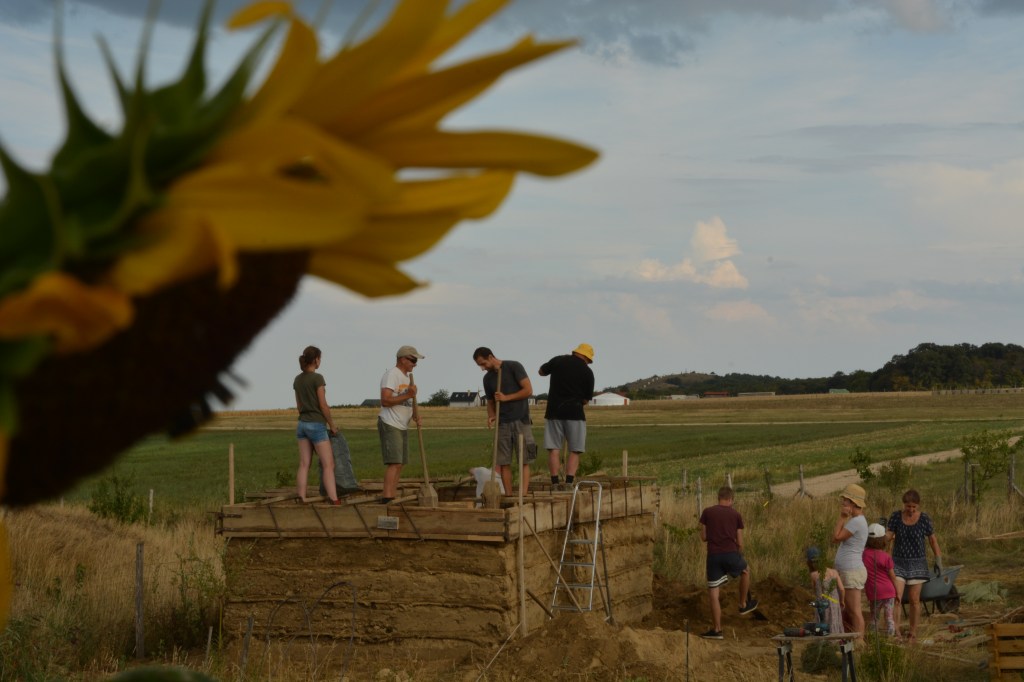
Kaláka is a two-part documentary that investigates the dynamics that emerge within the context of a rammed-earth hut that was built over two summers during a couple of hot summer days in Nemesvámos, a small village lying near the northwest side of Lake Balaton. The building –initially intended as a toolshed– transforms into a living space as the people constructing it come to appreciate the physical work, mental effort and the time put into it.
The films are meant to be a loose guide to making traditional rammed-earth structures, but with a focus on documenting the processual details that emerge from the materiality and sociality of the site. The traditional design features paired with the materiality lends itself to a very resilient structure that is durable when maintained and cared for, but which at the same time, has the ability to decompose fully back into the soil once its function is lost.
Rammed-earth as a building material carries great potential as it is widely available, cost efficient and customizable. The thick walls provide insulation from extreme temperatures naturally, which is becoming an increasingly important factor in building to withstand climate change. The main challenge today in building rammed earth structures does not lie in the scarcity of tangible resources but rather in the knowledge and know-how of building with soil. Furthermore, the communal systems of building rammed-earth structures is becoming increasingly scarce, especially in the Global North. These films aim to therefore highlight the importance of community in this building method, which is an inextricable part of the building process.
A fortuitous outcome of the project was Kaláka‘s inclusion in an MA thesis at Universität für künstlerische und industrielle Gestaltung Linz by Kaarel Kuusk and Rikunj Bharat Meeta Shah titled Earthen re[form]s: Low energy formworks for a convivial building process in rammed earth and adobe, which was successful defended in September 2023.
References
Gunda, Béla and Thomas A. Sebeok. “Work and Cult among the Hungarian Peasants.” Southwestern Journal of Anthropology 3, no. 2 (summer 1947): 147-163.
 Culturing Care